
Have you ever typed a business idea into an AI tool and watched a full website appear in thirty seconds? It’s genuinely impressive. The colors look okay, the layout is familiar, and there’s even placeholder copy that sounds almost like you wrote it. So the obvious question: why would you hire a designer at all?
Let’s dig right in — because the answer matters more than most AI vendors want you to think about.
What AI Tools Actually Do Well
To be fair, a lot. Tools like Claude Design, Lovable, Canva, and others have gotten remarkably good at generating a starting point. Feed one a prompt describing your business, and it’ll produce a homepage with a hero section, a services grid, a testimonials block, and a contact form — structured, responsive, and visually coherent. For someone with no design background and no budget, that used to be out of reach. Now it’s a ten-minute afternoon project.
Claude Design, in particular, is worth calling out. It can generate full UI mockups and page layouts from a plain-English description. You describe what you want, and it produces something you can actually look at and react to. That feedback loop — describe, see, refine — is a genuinely handy way to explore ideas quickly. As a kickstart, it’s hard to beat.
The problem isn’t what these tools generate. The problem is what happens when you stop there.
The Gap Between Generated and Genuine
AI tools are trained on patterns — millions of websites, layouts, and color combinations that have worked before. So when they generate something for you, they’re producing a plausible average. A statistically likely website. That’s not a criticism; it’s just the nature of how these systems work.
But your business isn’t an average. Your clients aren’t interchangeable. The thing that makes a local accounting firm worth hiring over the one three blocks away isn’t their services list — it’s something subtler. Personality. Trust. The sense that these people actually get what you’re dealing with. A generated website can’t know that, and it can’t communicate it.
Here’s what I’ve noticed working with small business clients: the sites that convert — that actually get people to pick up the phone — are the ones where the copy sounds like the owner wrote it on a good day, the photos are real and specific, and the design choices feel intentional rather than assembled. None of that comes from a prompt.
Where the Wheels Come Off
Let’s get specific about what AI-generated sites tend to get wrong — not because the tools are bad, but because they’re operating without critical information:
- Brand voice. AI copy is grammatically clean and semantically correct. It’s also often indistinguishable from every other site in your category. If your business has a distinct personality — dry humor, blunt expertise, genuine warmth — AI copy usually sands it off.
- Visual identity. Generated color palettes are inoffensive. They’re also forgettable. Real brand colors come from somewhere — a founder’s instinct, a competitive gap in the market, a feeling you want clients to have. AI picks from the middle of the road.
- Trust signals. What makes someone trust you enough to reach out? It might be a photo of your actual workspace, a story about why you started this business, or a testimonial from a recognizable local name. AI doesn’t know those things exist.
- Technical decisions. A generated layout might look great in a mockup and fall apart on mobile, load slowly on budget hosting, or be impossible for you to update six months from now without breaking something. These aren’t design problems — they’re engineering problems.
- SEO that actually fits your market. AI can fill in meta descriptions and headers, but it doesn’t know your city, your niche search terms, or how your customers actually describe their problem before they find you.
The Right Way to Think About AI Design Tools
I use AI tools in my own workflow. A lot, actually. They’re genuinely useful for generating layout options to react to, drafting copy I can then rewrite in a client’s voice, and quickly exploring what a page could look like before committing to a direction. That’s a great use of the technology.
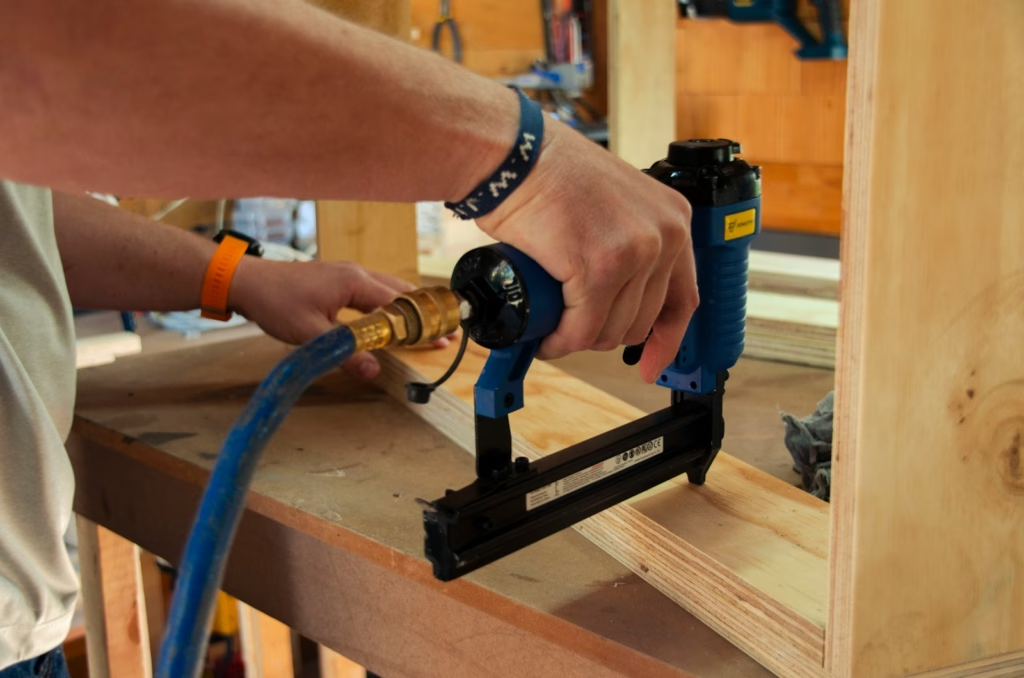
Think of it like a contractor using a nail gun. Fast, accurate, good for volume. But the nail gun doesn’t know where the studs are, doesn’t understand the load-bearing walls, and definitely can’t tell you why the previous owner made a strange decision that you’ll need to work around. That’s the craft part. That’s what takes years to develop.
A skilled designer or developer uses these tools to move faster — not to skip the thinking. The output still needs someone to look at it critically, ask hard questions, and make intentional choices rather than accepting plausible defaults.
What a Human Brings That AI Can’t
When you work with an experienced web designer or developer, you’re not paying for pixels on a screen. You’re paying for:
- Questions that reveal what you actually need versus what you asked for
- Judgment about what your competitors are doing — and what you should do differently
- An outside perspective on how your business reads to a stranger
- Technical decisions that will hold up two years from now when your business has grown
- Copy and design that sounds and looks like you, not like a template of you
- Ongoing partnership when something breaks, your needs change, or you want to expand
That last one is underrated. A website isn’t a one-time thing. It’s a living part of your business, and the person who built it should be someone you can call.
Be authentic
AI is changing web design — genuinely and fast. The best tools today can produce something that would have taken a junior designer a full week just a couple of years ago. That’s not going away, and it’s not worth pretending otherwise.
But a website that represents your business well isn’t just a collection of sections that look reasonable. It’s a first impression, a sales tool, and a signal to every potential client about whether you’re worth their time. Getting that right still requires a human who knows what they’re doing — and who cares about the outcome as much as you do.
If you’re a small business owner weighing the DIY AI route against working with someone, I’d love to hear where you landed — and what made the difference. Drop me a line.